Tuesday, November 14, 2006

The Magic Door


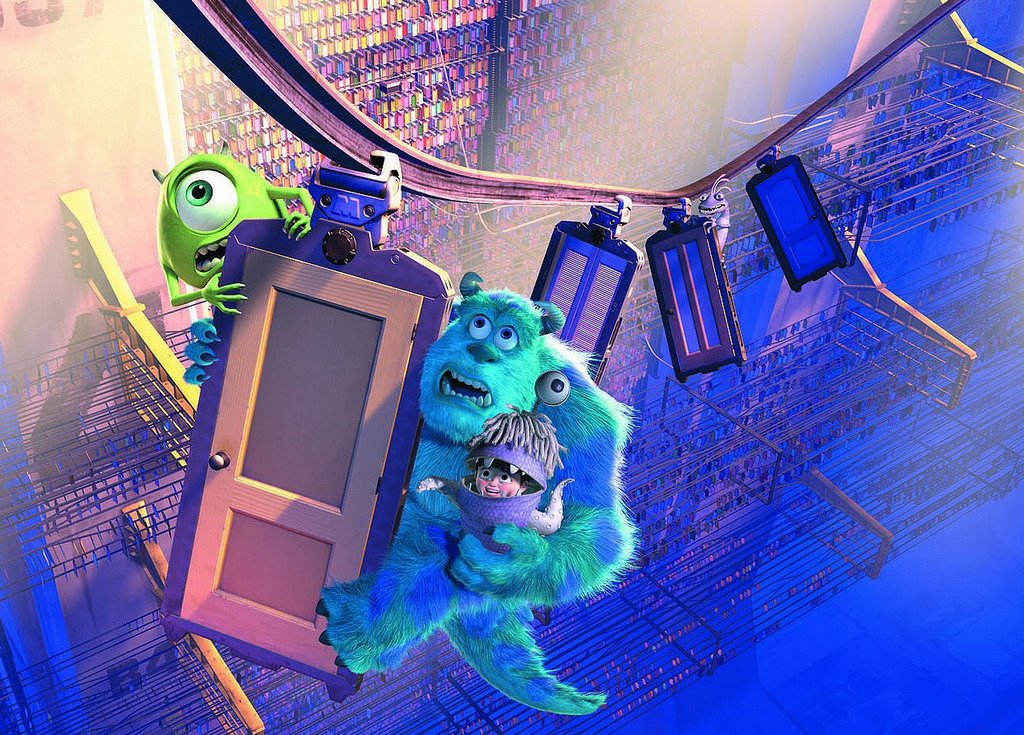
A central concept in Pixar’s hit “Monsters Inc.” is a magic door through which the workaday spooks of Monstropolis can travel to the human world to collect the screams of children.

These dimensional portals instantly captivate the imagination. What viewer does not come away from the film with a secret wish to step through such a door, to be instantly transported from one exotic location to another? And with a warehouse full of magic doors stored like dry cleaning on a moving/hanging conveyor, the possibilities for a personal journey through a raucous dimension-hopping Disneyland attraction are endless.

Like the plunge into Alice’s Wonderland rabbit hole or the leap from the Darling nursery into flight with Peter Pan, here is a truly visual and experiential story conceit, ready-made for Imagineers to exploit.

When California Adventure’s only dark ride, the shockingly ill-conceived “Superstar Limo” - - a bad acid-trip chase through the Touchstone Hollywood of cheesy B-celebrities (and Cher) - - was retrofitted as a “Monsters Inc.” ride, there was cause for celebration. Even on a limited budget and with a locked track layout, a C or D level dark ride through those magic portals couldn’t help but tickle the wishbone of our fancies. After all, it wasn’t the extravagant budgets of the old Fantasyland rides that made them favorites for 50 years, but their ability to convincingly transport the rider to Never-Never Lands of our imagination.

Yet, when the awkwardly titled “Monster’s Inc: Mike and Scully to the Rescue” attraction opened to the public, it was many things: cute, pleasant, mildly amusing, sure to charm the kiddies, a huge improvement over the prior tenant - - but, well, yet another dark ride disappointment that falls short of its promise.

Though we see magic doors, pass magic doors, even find a warehouse of magic doors, we are never taken THROUGH one single magic door.

During the ride, we are teased with, but never actually given the wish, the desire, the key experience. It’s foreplay without penetration. Monstropolis Interruptus.

(Well, there IS a colorfully painted plywood door on the exterior facade that “transports” us from the sidewalk to the queue, but this is somehow less than magical…).


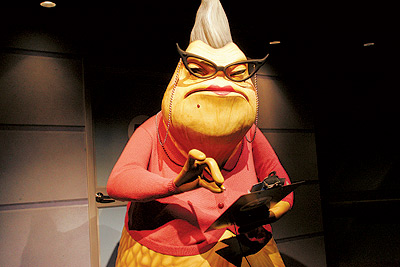
Rather than traveling through dimensional portals – an experience we are unlikely to have outside of Disneyland – we find ourselves stopping to “interact” with a cranky secretary robot spouting custom insults (already a daily annoyance for most of us in industrialized nations).

Like so many of the Disney dark rides of recent years; “The Many Adventures of Winnie-the-Pooh,” “Journey Into Imagination,” “Superstar Limo,” “Roger Rabbit’s Cartoon Spin,” “Buzz Lightyear’s Astro Blasters,” “The Great Movie Ride,” even the neo-classical “Splash Mountain” - - we are carted past stagey, episodic, distant set-pieces like tourists in a Disney Store wax museum.

We become mere passive spectators of a contrived scenario, burdened with more plot than necessary (“Help save Boo from blah, blah, blah…”). We are watching a mini-version of the film, not participating in it.

It’s a marked contrast to the original Fantasyland dark rides in which the guest was plunged into a first-person experience AS Snow White or Mr. Toad - - or the pinnacle 60’s triad of “Pirates of the Caribbean,” “The Haunted Mansion” and “Adventure Thru Inner Space,” which took voyagers on extravagant first-person journeys to fantastic other-realms of the historic, supernatural and psychedelic.

Walt wanted “Pirates” to make people feel like they were in the middle of a cocktail party, tuning in and out of the enveloping action. We were not passive-viewers at a modern amusement park, but part of a fantastic story come-to-life! The action is not confined to static sets on the right or left, but surrounds us in every way. We are lead in, on, over, under and through the story, not just past it.

This of-the-moment approach has proved to be far more durable and repeatable than the complex, episodic storylines and overwritten backstories of more recent creations. These elements seem to help the writers more than the riders.

Who cares what the dead bride’s silly maiden name might be - - why Boo is being kidnapped - - or why our vehicle is being hijacked? Talky exposition always hits the Omnimover like a lead balloon. When poorly written or staged, it can all-too-easily remind us that this is an artificial experience.

If the ride is so un-involving that I care to crick my neck trying to see the nostalgic remnants of a former, superior attraction - - or to spot kitschy design trivia - - there is a big problem. Do the storytellers really believe in the illusion at hand? If they don’t, we won’t.

Walt’s original Imagineers had all cut their teeth on that most completely visual of all filmmaking genres, the cartoon, and that experience clearly made a difference in their more elemental approach to theme park story. A simple situation with a visual/thematic progression and climax would suffice, much as it did for a cartoon short or a single sequence in an animated feature.

While cartoonists undoubtedly contributed gags and ideas to “Monsters, “Pooh,” or “Splash Mountain,” the overall product doesn’t feel much like it belongs to them, but more to a committee. Those show designers more experienced in technology, engineering, architecture, real-estate, marketing or theatre lack the same gift for immersion, non-verbal showmanship and elegant simplicity. Their priorities lie elsewhere.

It’s not obtuse theme park logistics and theory that matter to guests, but a transcendent emotional and visceral payoff. Those early Imagineers seemed to know instinctively what part of the story a rider wanted or needed to experience - - whether that concept was derived from a film or an entirely original situation. They could convincingly visualize themselves into the role of protagonist on an epic adventure. And we would follow them gladly.


As one wag put it, “Watch Alice go down the hole… or go down the hole? I just can’t decide.”

The magic for Disneyland guests was always the ability to travel THROUGH dimensional doorways to other worlds.

Disneyland needs more Magic Doors and fewer Hidden Mickeys.

Friday, November 10, 2006

The Sacred and the Profane


One of the most revolutionary aspects of Walt’s breakthrough park in Anaheim was its attention to comforting visual transitions from one disparate themed area to another. As guests moved from the Victorian gingerbread of Main Street to a time worn Bazaar on the edge of a distant jungle the connecting rooftops, fencing and plantings gradually transformed. The goal for the early Disneyland designers was to never jar the guests eye as they moved from one ‘story’ to another; the concept much like a cross dissolve between scenes in motion pictures.

This uncanny attention to visual harmony became a cornerstone philosophy in the design and execution of Disney’s theme parks for years to come, not only serving to keep guests in the park for an entire day but assuring they'd come back for more year after year.
Once the Accountaneers stormed the castle, however, not only did the clever visual transitions between fully realized worlds bite the dust but the very worlds themselves did as well.


Nowhere is this tragic reversal of fortune more apparent than at Disney’s Animal Kingdom in Orlando. Most of the theming here is of the highest caliber, often surpassing even the best efforts of the finest Walt era Imagineers. Joe Rohde and his team have created beautiful worlds within worlds that verge on spiritual epiphanies. From the eye-popping authenticity of a meticulously recreated African or Asian village to the intimate beauty of the Pangani Forest and Maharajah Jungle trails this is a park that deepy understands the worlds its creating, wrapping the guests not only within a convincing environment but within a distinct feeling.


But then there’s Dinoland U.S.A., specifically ‘Chester and Hester’s’ Dino-Rama’, an area so sharply out of step with the rest of the park that it borders on blasphemy. Stumbling upon this loud kiddy playground after a peaceful stroll around the wondrous Tree of Life is like tripping into a pool of vomit after leaving St. Peter’s Basilica.


Blaring, vigorously repellent, patronizing, cheap and visually offensive, this carny hell-hole appears to have taken its theme from traveling fun-fairs; the kind that are quickly loaded and unloaded from the back of U-Haul trucks. One can only imagine that this addition was bourn from the spreadsheets of some Strategic Planning MBA who figured the kiddy quotient wasn’t getting it’s full share of yuks from a park that appeared to skew too ‘adult’, Walt’s admonition to entertain adults and children together long forgotten.


Though Dino-Rama might elicit pained smiles in Peoria, it severely cheapens Disney’s Animal Kingdom; a park that, at its best, reminds guests once again what the ‘theme’ in theme parks really means. That it appears in any Disney park is sin enough, but the fact that it’s butted up against some of Imagineering’s most sublime work in recent years is deeply heartbreaking.

Saturday, October 21, 2006

Taking a Seat


When Roy E. Disney accused the Eisner regime of building Disney's California Adventure "on the cheap" it was very clear what he was talking about. Here was a park filled with off the shelf amusements contracted out to less than stellar vendors, no distinct themed areas and nary a penny spent on new show technology, save perhaps Soaring Over California's remarkable hovering benchseats.

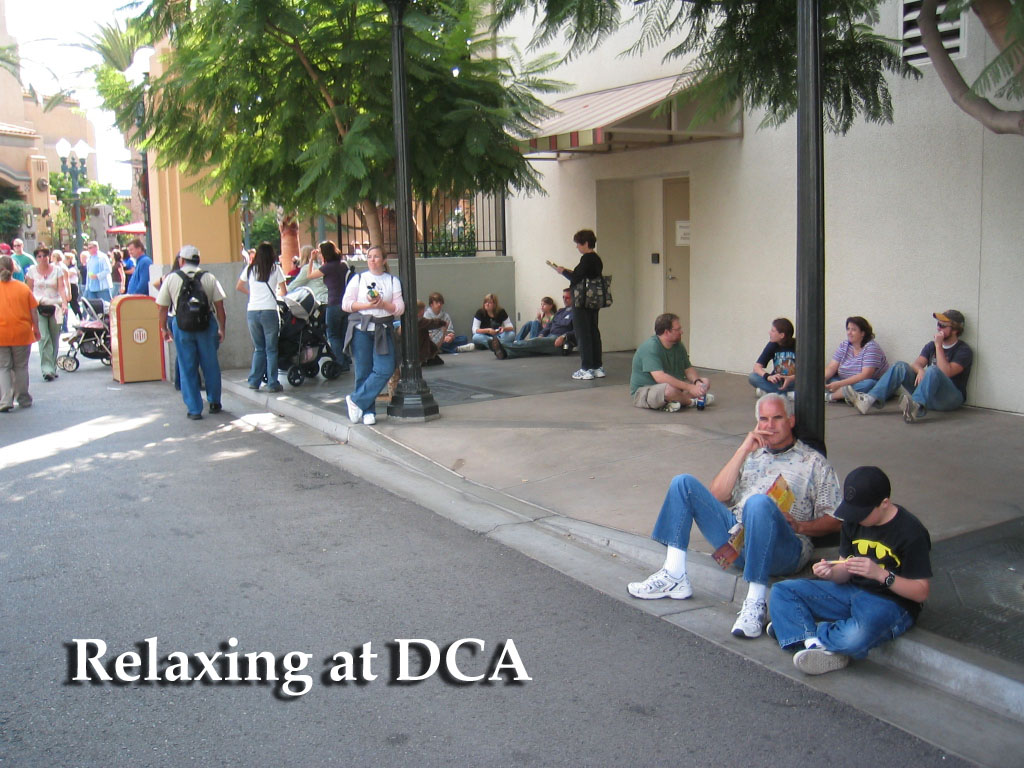
But what the park's few guests may not realize is that the 'cheap' across the street from Disneyland went far deeper than Wal-Mart style thrills, mall esthetics and empty sightlines. When it came to the comfort of patrons, DCA proudly demoted the guests to third world refugees by not fully budgeting for one of the most rudimentary of theme park provisions: Outdoor seating.

We all know what happens to guests non-plussed by their stroll along Paradise Pier. They leave and never come back. But what about the few remaining souls who haven't yet given up the faith? What happens when, after searching vainly for any element of charm in the park, guests now need a quiet place to rest their weary feet?


It appears that when it comes to taking a break from your glorious California Adventure Disney would rather you please remain standing.

Wednesday, October 11, 2006

Positive Signs


A baby step forward is still progress, no matter how small.

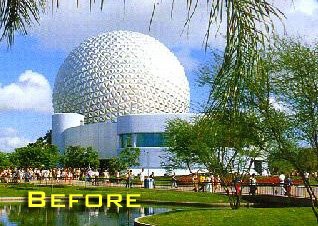
Whether it was due to Exxon's sponsorship pull-out of Epcot's Universe of Energy or an astute management decision from someone at Disney with taste, the aggressively ugly marquee that sat beside the pavilion is now history. No longer will guests be barraged by over-zealous splashes of mauve, crowded visual elements, pop-icon mugging, covert explosions of pink triangles, incongruous type fonts and golden dinosaurs all randomly glued to a cheap milk crate backing. This was a visual eyesore so discomforting it didn't belong at a Six Flags park, let alone Epcot Center's classy Future World.

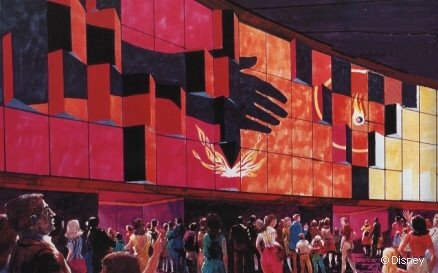
On the other side of the country the final retro touches have been affixed to the once equally ugly Club Buzz at Disneyland's Tomorrowland. Also back is the original name for the area, The Tomorrowland Terrace. A lone designer at Disneyland's Entertainment Division saw fit to pay homage to the timeless design sensibility of Disney's legendary Imagineer Rolly Crump and his original modernist motif for this unique rising bandstand. Though not an exact re-fit of Rolly's whimsical airy space-age planters, it's a genuine and heartfelt nod to his take on a promising optimistic future. Club Buzz, on the other hand, was a heavy, brooding, dystopian monolith that sucked all the life out of the area.


Those that value great design and a quality guest experience right down to the smallest detail have reason to rejoice at these recent, albeit minor, changes. Progress at a snail's pace is still better than decay and destruction at any pace.

Thursday, October 05, 2006

The Irrelevance of Mark Twain's Tom Sawyer


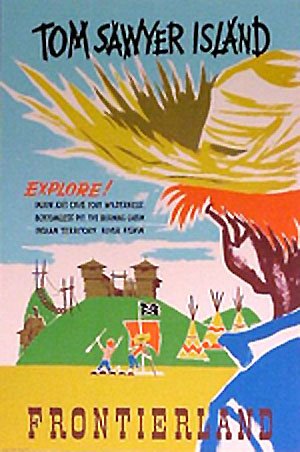
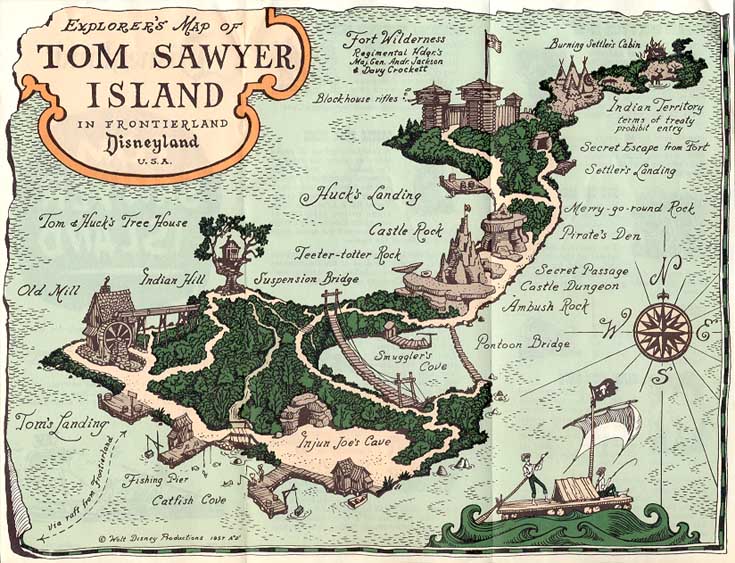
Yes it's true. Jay Rasulo and the marketing minions at Disney Corporate are pushing hard for a rushed tear-down of Tom Sawyer's Island to make room for a Jack Sparrow themed Pirate Playground in May of 2007.

Those within the Orwellian confines of W.D.I. now tasked with shape-shifting this classic Walt inspired island of adventure and brave enough to talk about it generally don't agree with their new mandate. Driven hard by the movie's financial success, this is a decision that is both knee-jerk and wrong.

The argument that is being used is that the Island is no longer being attended, so W.D.I. must make it "relevant".

Just when did attendance drop? Was it when the fort shut and locked its entrance gate? When the bridges were temporarily run down and closed? When the allure of a burning cabin was shut off? When water traffic backed off with the loss of the Keel Boats and slimmed down Canoes? When the designated "smoking area" for that region was moved to the load/unload of the rafts?

So now what? Collective wisdom at Imagineering is that the disease has been mis-diagnosed. But no one in upper management seems to care about the legacy of Disneyland anymore. It's old fashioned, and long-term apparently does not appeal to Wallstreet.

Okay, so Disneyland is not a museum. Still, some things are just fun!

But only when they are working the way they had been designed to.

Tuesday, September 26, 2006

Walking in Walt's Footsteps


John Hench often talked about Walt's desires for his staff of Imagineers at W.E.D. to visit the Park often.

"You guys get down there at least twice a month. For God's sake, don't eat off the lot. Stay there... lunch with the guests... talk to them."

Why would Walt Disney suggest such a thing? The answer is of course very simple. Walt understood that the only way to discover what works and what does not work is to experience it for yourself. You must have a personal emotional response in order to progress with any sincerity. Think of the potential strength of your creative work force when they have been educated by their own product. Walt thought about that very thing.

How often have you experienced great joy at a Disney theme park? Was it your Jungle Cruise Skipper with his impeccable comedic timing? Was it seeing the family of ducks that crossed the parade path over to the StorybookLand canal for a swim? Was it the smell of fresh buttered popcorn? Now, do you personally feel qualified to tell your family, friends and/or peers about all of these things?

Of course you do.


How often have you experienced disappointment at a Disney theme park? Was it a crowd control Cast Member who was rude because you did not know which way to traverse Main Street in the evening? Was the restaurant you were anticipating the most closed early or not open at all? Was the restroom you went in to unclean, with a mysterious wet floor? Again, do you feel personally qualified to tell your family, friends and/or peers about those same things?

Yes. In fact, you become the most qualified, just for having been there.


But, what if the extent of your theme park visit was a piece of paper handed to you some 40 miles away? The contents therein being such information as- 37% of the clicks through the turnstiles may not have experienced Space Mountain today due to periodic attraction closures? This same paper also tells you that churro sales are up 5% from the same peak Saturday a year ago. What is your emotional reaction to that information? How interested are you in making sincere attempts to resolve any negatives in such reports? How damaging is it for a person who is in a position of decision or influence to only see the theme park guests as numbers or percentages on a spreadsheet?

Walt knew what he was saying when he would stress the importance of going to the Park. He knew, because he was there as a guest.

Frequently.


Strike Up The Band!


Let the drums roll out! Let the trumpets call! Let the people sing! Strike up the band!

It may be appear to be an insignificant trifle in the great corporate universe of the Disney Company, but the re-installation of a classic Disneyland detail gives all those who care about good taste, timeless design and the heritage of Walt's classic theme park reason to rejoice.

Rolly Crump's fanciful space-age planters that festooned the original Tommowland Terrace bandshell appear to be making a return. For three decades this classic Disneyland icon never lost its design appeal or its ability to transport guests to a groovy sleek and optimistic world of tomorrow. When Rolly's imaginative ornamentation disappeared with the installation of Club Buzz, a heavy-handed, grim and aggressively unappealing redressing of the stage in 1998, Disneyland not only lost a peice of great design from an accomplished artist but it lost a bit of its heritage as well.


But somewhere, somehow, someone at Disneyland's Entertainment Division is fighting the good fight. To those who reinstated this glorious Disneyland gem, bravo to one and all.

May this be the beginning of a great big beautiful tomorrow.


Monday, September 18, 2006

Thursday, September 14, 2006

Communi-clutter


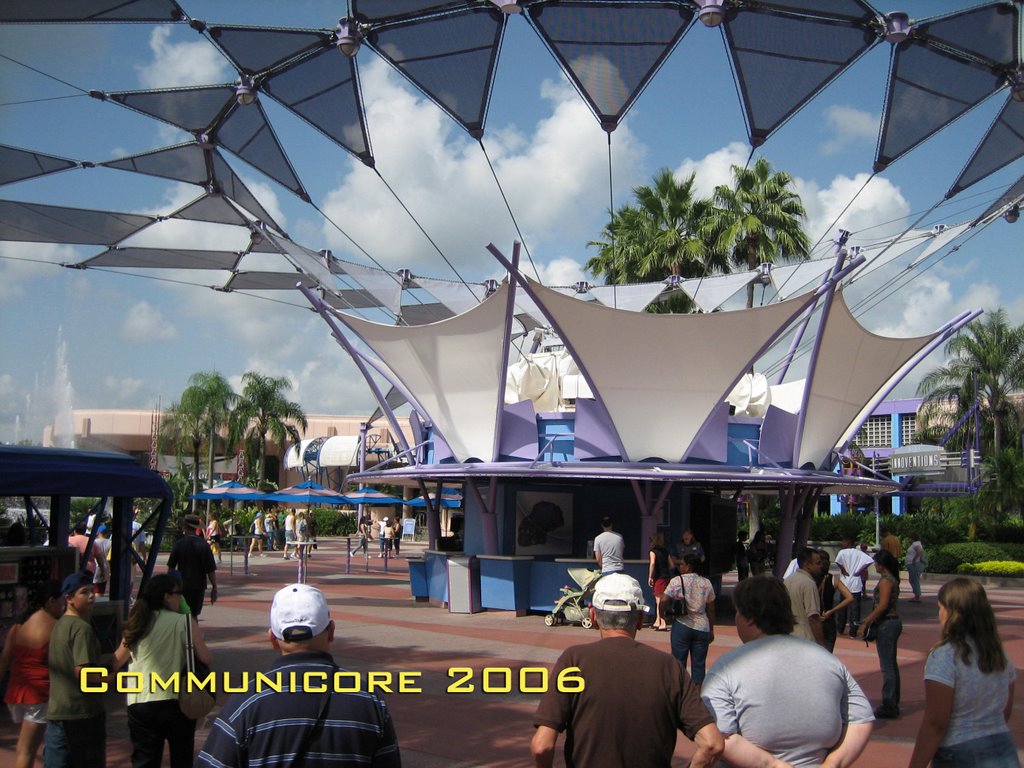
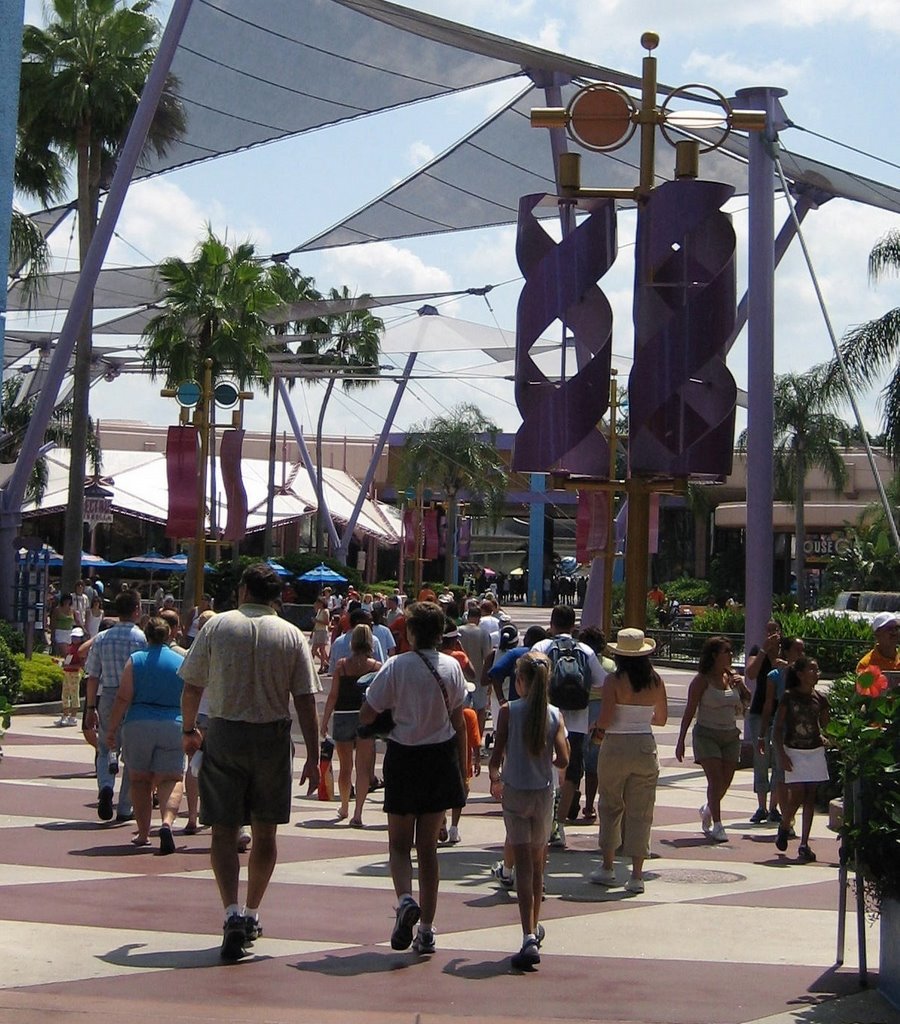
Words can’t begin to truly describe the mess that has befallen Epcot’s Communicore. Infact, weeks have passed and still this writer struggles to find the perfect analogy, the sterling turn of phrase, the precise metaphor to summarize the visual nightmare this once comforting futuristic landscape has become.

The clean spartan lines are gone now; the simple visual statement completely covered over in designer excreta. Where less was much more, now more apparently isn’t more enough. Where the original Imagineers worked overtime to create a visually pleasing forward thinking urban environment, later embellishers, well schooled in the art of ugly, spared no expense in making a mockery of Communicore’s once pure and reassuring architectural statement.


Giant metal poles, tightly affixed with metal bolts, painted in garish grunge-mall mauve now spear the landscape. Twine and sharp edged tarps splay out over the area like malevolent fish nets descending for the catch. Add to that endless metal doo dads and twirly gigs, spinning whozits and whatzits, towering kiosks and assaultive souvenir pushcarts, billowing tents and oversized umbrellas. And all of it stirred up with a healthy helping of cheap.

The gentle sensuous lines of Communicore East and West are barely discernable now; the grand vision suffocated by the very worst in bad taste.

Shame on the perpertrators.

Shame.


Saturday, August 19, 2006

Elemental Losses: Water


Initially The Great Movie Ride was going to be part of a show business themed attraction at Epcot but the powers that be felt it was strong enough to anchor an entire new theme park. And so, in May of 1989, the Disney MGM Studios was born.

If The Great Movie Ride was going to be the flagship attraction at the new park it was appropriate that the first in its more than ten movie set pieces be one of the most elaborate.

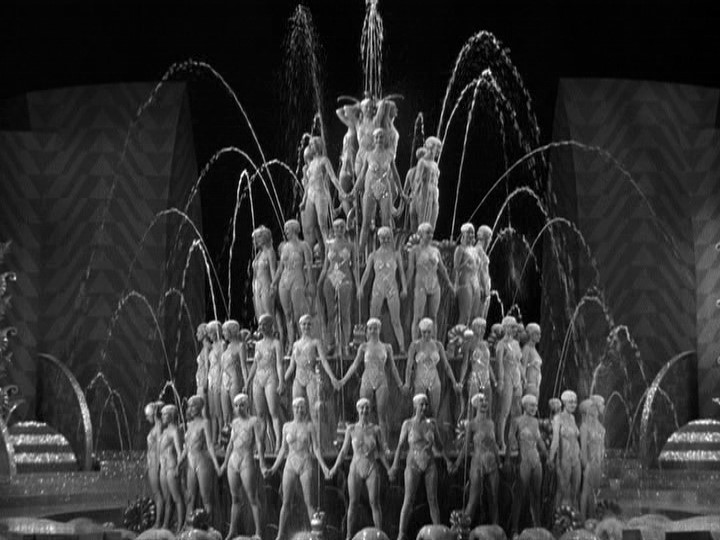
And elaborate it was; a faithful recreation of the five tiered cake of bathing beauties in 1933’s Footlight Parade, specifically one of Busby Berkley’s showiest numbers, ‘By a Waterfall’.

Imagineers didn’t scrimp on the details. Just as the set appeared in the film, each of the five tiers rotated counter to one another while fountains of water sprayed from ornamental gold deco jets trimming each layer. To top it all off, designers added three shimmering caped beauties on diving boards to the right of the set and filled the room with very real bubbles. When the switch was finally flipped on this extravagant movie musical recreation it was truly a sight to behold; a magical glittering tribute to the spectacular showmanship of Busby Berkley at the height of his craft and a fitting introduction to Disney’s Great Movie Ride.

But in perhaps one of park managements most egregious exploitations of the whole ‘If It’s Broke Don’t Fix It’ dictum, this was yet another spectacle that wasn’t going to last.

As with virtually all new attractions, technical and engineering issues are bound to crop up and this one was no exception. What the actual problems were depended on who you talked to; the mechanism that turned the giant cake was problematic, the foundation was cracking, water was leaking, mold and mildew was forming and/or the set was incurring water damage.

Maintenance staff whined up a blue streak, and eventually word came down from above that the expense of upkeep just wasn’t worth the payoff.

With the bane of unavoidable mechanical problems it certainly makes some sense to sacrifice a single show element here or there to save the intergrity of others, but the changes to this one Movie Ride set were so massive and all-consuming that one had to wonder if they weren’t inspired by someone in management who personally found the whole 1930’s Busby Berkley esthete morally and ethically repugnant.

Firstly, the entire cake set was curtained over by a giant scrim so that its reveal could be shortened. Then the art deco painting details on the walls faithfully recreated from the movie were removed as were the three bathing beauties and their diving board perches. Lastly, the mechanics that made each separate tier of the cake rotate were turned off, the animated lights unplugged and the bubble making machines removed.

And despite this being a recreation of a number called “By a Waterfall” guests would no longer see a single speck of water in the whole set. Those pesky water fountains were turned off for good.

So today visitors who enter The Great Movie Ride’s Footlight Parade set now witness a less than impressive slide show of Berkley formations on that giant scrim punctuated by sporadic hazy reveals of the Footlight Parade cake behind it; no deco details, no motion, no animated lighting, no bubbles.

No water.

Guests would just have to be trusted to not know what they were missing.


Tuesday, August 01, 2006

Elemental Losses: Fire


If the Kodak Corporation’s 1970’s era boast that more photos were snapped per day at Disneyland than any other place in the world, then you could bet that when the Mark Twain Steamboat or Columbia Sailing Ship rounded the northern bend of Tom Sawyer Island back then one photo spot in particular would threaten to usurp the crown from Sleeping Beauty’s Castle, or, for that matter, Paris' Eiffel Tower.
 
It was Frontierland’s infamous Burning Settler’s Cabin and every time any of the guests onboard any Rivers of America water craft caught sight of that stack of logs on the edge of the bank fully engulfed in very real flames every last soul rushed to the edge of the boat, cameras clacking away like an over caffeinated secretarial pool, the deck listing precariously to starboard.
 
Though the entire vignette was certainly photo-worthy, what with an early pioneer hunched dead over a log out front, an Indian arrow stuck clean through his chest, it wasn’t really the gruesome crime scene that caught the fancy of snap happy tourists.
 
It was that burning cabin.
 
Certainly filmmakers and visual storytellers instinctively understood that human nature can’t resist gawking at train wrecks or peeping through a neighbor’s window no matter how untoward the practice. Walt and the gang, who certainly knew as much, were more than happy to set the stage, light the fire and then actively solicit Disneyland adventurers to gawk to their hearts content.
 
And for decades guests did just that, shamelessly clicking and whirring through endless rolls of Kodachrome and Super-8 film the moment they spotted the first flicker over the embankment.
 
As time went on, however, political and economic forces threw a wet blanket over Walt’s little waterside bonfire.
 
In the 1970’s the energy crisis compelled management to turn the flames off, collective wisdom being that this was an enormous waste of fuel. Truth be told, the cumulative gas used to keep the cabin ablaze was an incredibly trivial sum when compared to the rest of the park’s total usage.
 
In the politically correct decade to follow the idea that Indians were apparently being vilified as the cold blooded murderers of early Pioneers (despite the fact that greedy homesteaders probably deserved such a fate), was deemed too difficult for Disneyland guests to process and so out came the Indian arrow and in came a less risky story line, this one showcasing a sleeping moonshiner who’d inadvertently set fire to his cabin. Or, depending on how the Disney Gods felt about the fire effect from one week to the next, merely a story about a sleeping moonshiner.

But somehow even this angle didn’t sit well with Disney Management, the whole alcohol issue now being deemed too spicy for modern family audiences.
 
So now the ‘Endangered Bald Eagle Nest’ scenario was given a go, this story being that of an environmentally unsympathetic settler who had inadvertently set fire to his cabin and thus endangered a nest of eagle chicks roosting right above the roof line.

One Frontierland cast member who operated attractions there from 1969 through 1973 was, to say the least, a little befuddled when the latest dumbing down of the cabin was unveiled:
 
“First, show me a bald eagle that builds a nest ten feet off the ground. And second, show me someone who can build a log cabin with only basic hand tools and then cannot contain a fire in a stone fireplace. I do not think this is at all verifiable or historically accurate.”
 
And then, suddenly, the fire was turned off. Then on. Then finally off for good.
 
One could argue that the idea of Indians killing off settlers is a little off color. Or that viewing faux corpses at Disneyland is distasteful. Or that the expense of keeping real flames lapping at the side of an outdoor cabin set for hours on end day after day is a global warming nightmare.
 
But you can’t argue the fact that stumbling upon the sight of a log cabin fully engulfed in flames in a far off corner of Disneyland was one of the coolest experiences a kid and his parents could share together. Moonshiners, careless pioneers or ruthless Indians were beside the point. It was that audacious outdoor conflagration that wholly captivated Disney guests for years.

As with all Eisner era decisions affecting the parks, economics would always trump politics. Any off the beaten path Disney era detail without a measurable profit margin that required upkeep above and beyond a fresh coat of paint every three years was not worth tending to. All the better if the decision to forego maintenance came with a touchy-feely culturally sensitive excuse to placate disgruntled guests.

But it’s just these surprising little show elements, these ‘hidden gems’, scattered throughout the Disney Parks that make the guest experience such a magical and transporting experience. There’s no real reason why the Settler’s Cabin can’t once again burst into flames to delight new generations of pyromaniacal children. If Imagineers can’t find a new high-tech energy efficient way to bring back that fire of old then they shouldn’t be called Imagineers.

A convincing dimensional outdoor fire illusion? I dare you.

Monday, July 31, 2006

Elemental Losses: Earth


When Imagineering legend John Hench, after a pre-opening VIP tour of Disney’s California Adventure in 2001, famously quipped, “I liked it better when it was a parking lot” it would have been easy to dismiss the statement as merely a wry and devilishly wicked smack-down of a theme park that deserved much of the criticism thrown its way.

But look beyond the surface giggles and you’ll find a level of of wisdom that is both disarming and a little profound.

For when the 15,167 space 100 acre parking lot was torn up and replaced with flashy shops, restaurants, movie theaters, hotels and theme park attractions something very special about the Disneyland experience was lost forever.

For early Disney Imagineers it was the ubiquitous parking lot that visually symbolized everything ‘today’ and as such gave guests a little heads up on a sign over the two entrance portals to Disney’s Magical Kingdom:

"Here you leave today and enter the world of yesterday, tomorrow and fantasy."

Walt and his designers knew that by carefully contrasting the parking lot’s wide grey expanse of cement and steel with the color and intimate pageantry of Main Street U.S.A. they’d be giving guests a carefully calculated jolt of sensory uplift the moment they left the entrance tunnel, much like the experience Dorothy had leaving the drab sepia world of Kansas and opening the door to a Technicolor Oz.

Today that classic bronze plaque above the entrance portal has lost much of its prophetic power. Well before arriving at Disneyland guests have already been assaulted and overloaded with so many over-scaled and conflicting thematic show elements that entering Main Street can easily feel like an anti-climax; victim to the visual cacophony right outside the berm.

And so that whoosh of excitement guests once felt as they left the entrance tunnels and entered into the worlds of yesterday, tomorrow and fantasy has been severely degraded by the loss of the original Disneyland parking lot. In his day Walt saw the parking lot as part of the over-all show. In our day Disney management saw the parking lot as a tremendous cash cow.

The Disney Guest, they figured, would never know what they were missing.

John Hench, however, knew too well.

Elemental Losses: Air


The sudden closure of Disneyland’s famous Skyway became the stuff of urban legend almost immediately after it closed in 1994. For 38 years it had carried guests between Fantasyland and Tomorrowland high above the air in gleaming colorful buckets. And then, suddenly and without so much as a press release, it was gone.

For the Disney faithful it just didn’t make sense. How could an attraction that had become such a staple of the Disneyland experience be shut down so unceremoniously; every last pylon uprooted and carried away in the dark of a single night.

It must have been because the attraction had become too litiginous they figured. Only a few months earlier a 30 year old man had fallen from one of the cabins and suffered severe neck and back injuries. Certainly Disney was right to assume that any additional accidents might tarnish the company name and ultimately the guest experience.

But for those more willing to face the darker side of Disney the truth could be found in the spreadsheets and pie charts floating around the executive offices of Disney Enterprises well before the accident. Cost cutters had dismissed the attraction as too little bang for the buck, with staffing expenses, maintenance costs and necessary safety upgrades demanding more capital than they felt appropriate. Randle Charles’ fortuitous fall from the Skyway became the perfect smokescreen for the purely economic decision that quickly followed.

Eventually Randle’s lawsuit was dismissed. Seems the 30 year old nutball had jumped, not fallen, and had he stayed inside his cabin the Skyway would have enjoyed a perfect safety record.

If Disney executives were waiting for another bogus excuse to shutter Walt Disney World’s Skyway they only had to wait five more years. In February of 1999 65 year old custodial host Raymond Barlow was accidentally scooped up and dropped 40 feet from a moving gondola when cast members started up the ride in the morning without checking the exit platform. Nine months later and The Magic Kingdom saw the last of its own Skyway; Disney executives smiling all the way to the bank.

And so the magical flights through mountains, past rocket ships and over lands of fantasy came to an end and all because the top Disney brass merely wanted to save some money.

The Disney Guest, they figured, just wasn’t worth it.

Tuesday, July 11, 2006

Feel All The Wonderful Motion


One afternoon in the summer of 1984 news spread like wildfire among Epcot Center cast members that the ‘Radok Blocks’ were finally fully operational. From one end of the park to the other operations hosts and hostesses quickly changed out of their costumes and rushed towards Universe of Energy in Future World East, converging on the pre-show theater directly inside the building.

Cast members familiar with the eight minute film that had shown there since Epcot’s opening in 1982 were immediately aware that something was off the moment they entered. The entire ninety foot wide screen used for the presentation appeared to be missing, now completely covered over in black. They wouldn’t have long to wonder as once the lights dimmed the mystery quickly dissipated. Like pristine white dominoes falling magically into place, the screen exploded out from the center in perfect synchronization with the film. From one end of the auditorium to the other you could hear audible gasps, all eyes now locked on this wonderous undulating surface.

Months later operators at Universe of Energy would joke about how quickly the room of 580 boisterous guests would brake to dead silence the moment the screen started throbbing to life.

An online fansite dedicated to preserving the Universe of Energy’s history summed it up:

“Saddling it with the term ‘pre-show’ is an injustice, given the connotations that the term carries. The original pre-show for Universe of Energy, the absolutely dazzling "Kinetic Mosaic" …was regarded by many as better than some main shows."

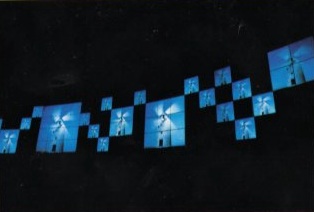
The movie, consisting of five 35 mm films running in unison, hadn’t changed when cast members poured into the building that Summer afternoon in 1984 but the screen very much had. Made up of 100 3½ foot square prism-shaped tiles, these ‘mini-screens’ consisted of two sides of a projection surface and one side non-reflective black. Each segment could show either a black or white surface, or allow one of several combinations with its point facing forward; the full screen capable of more than a billion separate configurations. Synchronized with the film, these tiles rotated independently or in concert with each other by way of individual servo-motors and all were controlled by microprocessors, making this the first time in film history where a computer was used to move elements within a film presentation.

And the effect was breathtaking.

The mastermind behind this remarkable presentation was the Czech film director Emil Radok who, with his brother, presented his landmark film ‘The Magic Lantern’ at the Brussels Expo in 1958, part of an experimental system of combining film projection with live performance. But it was his pre-show presentation at Epcot’s Energy Pavilion that was, ten years before he passed away, his most monumental and astonishing masterwork.

So complex and demanding was the technology behind Radok’s Kinetic Mosaic that each screen element was set to their default white position when Epcot opened and remained that way for two years while Imagineers continued to work the bugs out, not least of which was the unreliability of the 100 separate motors, each with its own precise braking system, required to operate the individual screen elements. So long had this screen lay dormant that when in-the-know guests asked Universe of Energy operators about why it wasn’t working they were met with, “What? The screen moves?”

Radok’s audacious show continued to wow audiences in the coming decade but challenged engineers on an almost daily basis. It was rare to see every block operational with guests often witnessing a row of at least four blocks locked to white when they entered the pavilion.

Two years after Emil passed away in Canada (where he’d been exiled from then socialist Czechoslovakia), Disney accountaneers decided they’d had enough of those un-reliable and costly Radok blocks and plastered them over with stationary screens, figuring a newer hipper generation of Disney guests would respond more favorably to the pop culture antics of Ellen Degeneres in a pure film format.

Disney management was probably correct in assuming that guests who didn't know what they’re missing wouldn't miss it; that ignorance is indeed bliss.

But some of us know better. Some of us enter that pre-show theater at Epcot’s Universe of Energy today and recall how our jaws dropped to the floor every time we saw that giant wall ripple to life. How we stared in wonder as wild fully dimensional images formed out of thin air. How we delighted in the whimsical play of shadow and light over constantly shifting shape and form. How even today this presentation was way ahead of its time.

And so we mourn what future generations will miss by not viewing Emil Radok’s masterpiece, an artist and filmmaker who truly made us, “Feel all the wonderful motion flowing through things far and near.”

Tuesday, July 04, 2006

Disneyland Civic Projects

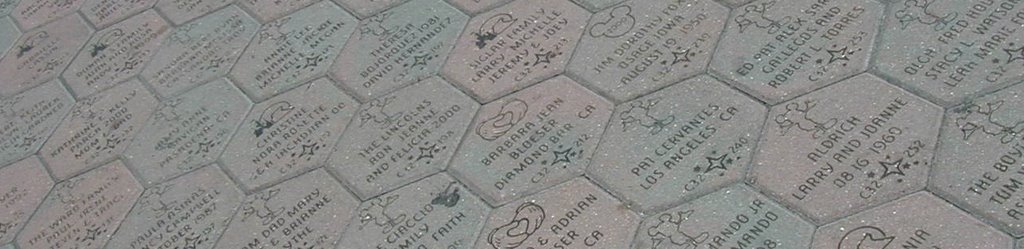
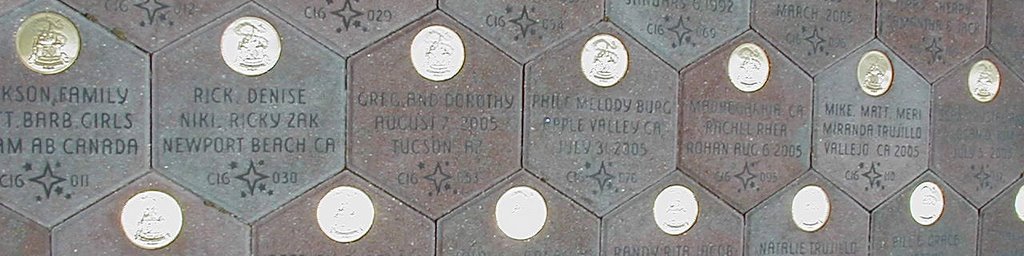
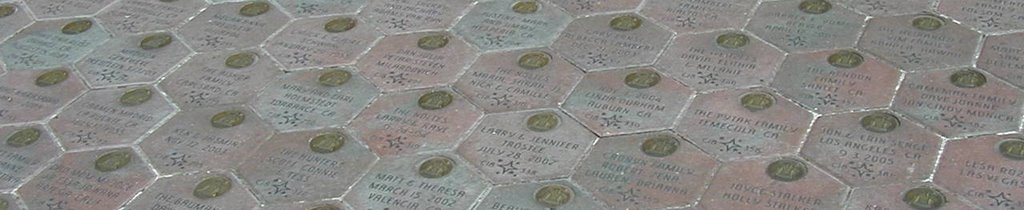
In the plaza between Disneyland and California Adventure, thousands of guests have paid in the neighborhood of $150. to commemorate the family name on a brick paver tile, a nostalgic memento to revisit in future years.

One could say they “own a piece of Disneyland.”

But what did they pay for, really, but a homely little tile? Unlike plaques at civil projects or hospital wards, the “donation” didn’t really contribute toward the creation of anything but the brick itself and some additional profit margin for Disneyland merchandisers.

Where is the lasting monument this kind of money could build?

With all the needed talk of Disneyland restoration and revival, the problem of finding budgets for atmospheric items like scenic locales, fountains and forts often comes up short.

Since it is assumed such details will not draw additional paying customers through the gate, but merely enhance the day for those already there, accountaneers don’t tend to see the necessity of aesthetic charm. While the purse strings appear to be loosening a bit these days, can we really expect this to change?

Does it fall on the shoulders of those with a passion for Walt and his artists to turn this bull by the horns? - - Not by begging, complaining or demanding the Company do something on their own dime (though that can produce some slow results as we have seen), but putting our monies where our mouths may be.

What if Disneyland were to draw up plans for the return of specific, historic park scenic elements, restorations or improvements in the manner of civic projects, soliciting funds for their execution?

If people will pay for a mere brick, wouldn’t they pay even more to own a piece of a mural, a tree house or a pirate ship? Especially a beloved icon they were reviving from their own childhood so it might last for generations to come?

Monuments for Walt Disney’s Disneyland by and for the people.

Donations could be solicited at varied levels, with a clear dollar goal set for work to progress. Donors would be noted on a bronze plaque at the location of the “monument”, just as it is in the real world outside the berm.

In this way, permanent artistic improvements could be made to the park's atmosphere, expenditures that don't always measure up to the Company reinvestment goals. And new WDC funds can then be dedicated to creating a roster of exciting new attractions, as they should be.

While this sort of plan would be impractical for the building of major attractions that require bigger budgets, constant maintenance and staffing, it could be just the thing for the little extra details that make Disneyland so special:

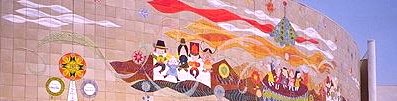
Mary Blair’s Tomorrowland Murals
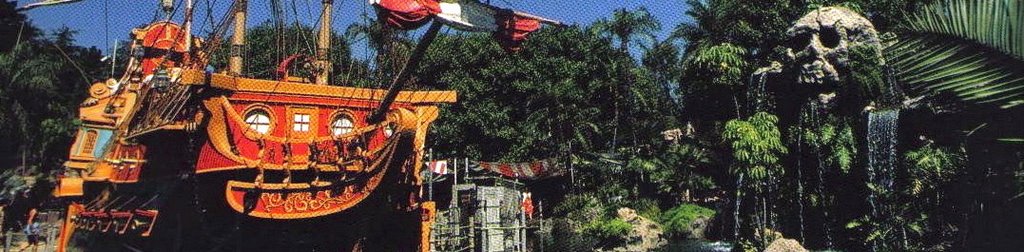
Captain Hook's Pirate Ship and Skull Rock
The Swiss Family Treehouse
Cascade Falls on the Rivers of America
Sleeping Beauty Castle Diorama
The House of the Future
Fort Wilderness
Tomorrowland Terrace Stage Design
Clock of the World

…would seem perfect for such a scheme, helping to bring back a bit more of Walt Disney’s wonderful world of color and design to the historic Magic Kingdom.

By online and in-park voting, the most popular icons could be selected. To avoid competitive, promotional or vanity projects, the focus would stay on historic Walt-era restoration projects – on which most can find common ground.

Are there a significant number of potential patrons… fans, animators, cast-members and common folk who would spend a little of their own cash to sponsor a Disneyland renewal project? To help bring back a bit of Walt and Mary and Marc and the rest?

To pay back to Disneyland a bit of the joy they have received from it over the years? I’d bet on it.

Who wouldn’t want to point out Captain Hook's Ship and proudly tell their kids that it partly belongs to them? And behind the ship, their named plaque awaits to prove it.

If Walt said, “Disneyland is your land,” why not let us all help to contribute to its future? After 50 years, Disneyland really belongs to us all.

Make that tile mean something.